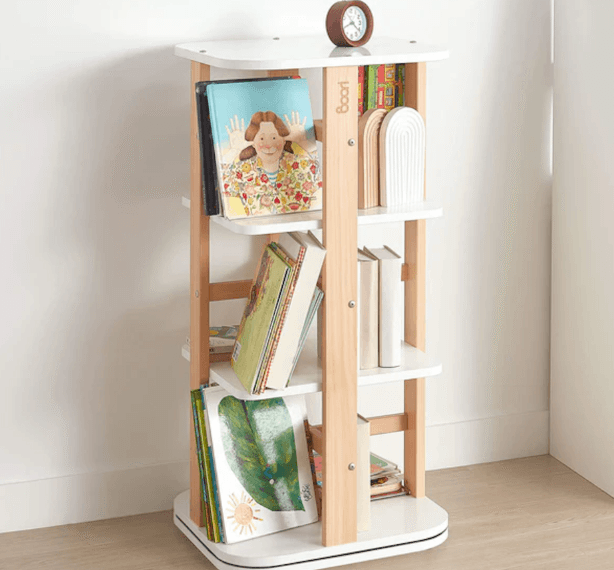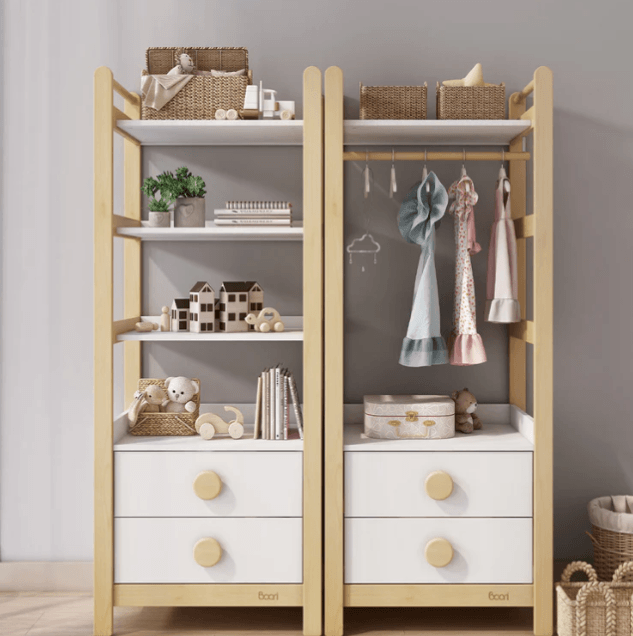
Boori shelves are children’s shelving pieces designed specifically for the Australian children’s bedroom market, covering front-facing display shelves for young children, standard spine-out shelves for established readers, rotating designs for small rooms, and combined shelving and storage configurations for families who want book display and toy organisation in one unit. A well-chosen Boori shelf does more than provide a surface for books. It makes books accessible and visible in a format suited to the child’s current developmental stage, which has a direct effect on how often children independently choose to read.
Key Takeaways
- Boori shelves are designed around how children at specific developmental stages access and interact with books, not around maximising book storage volume.
- Front-facing Boori shelves, which display book covers rather than spines, are significantly more effective for children under six at encouraging independent book selection.
- All Boori shelves are built to Australian safety standards as a baseline, with non-toxic finishes, rounded edges, and wall anchoring provisions standard across the range.
- The right Boori shelf depends on the child’s current reading stage, the room’s available floor and wall space, and whether combined storage is needed alongside book display.
- Correct placement of the shelf within the room is as important as the shelf design in determining whether it becomes a genuine reading destination.
Why the Right Shelf Design Changes Reading Behaviour
A child’s reading shelf is not a neutral piece of furniture. Its design actively shapes whether the child engages with books independently or ignores them. A shelf that presents books at the wrong height requires the child to stretch or crouch to see what is available. A shelf that presents spines rather than covers presents a wall of identical rectangles to a child who cannot yet read titles fluently. A shelf that is overfull makes individual books invisible. Each of these design failures reduces the frequency with which children independently reach for a book.
Boori shelves are designed to avoid each of these failures: correct height for the child’s developmental stage, front-facing display for children who navigate by cover, and proportions that display books clearly rather than cramming as many in as possible. The result is a shelf that children actually use.
Boori Shelf Formats
| Format | How Books Are Presented | Best For | Age Range |
| Low front-facing shelf | Covers outward at floor level | Board books and early picture books | 1 to 4 years |
| Mid-height front-facing shelf | Covers outward, multiple rows | Picture books and growing collections | 3 to 7 years |
| Rotating shelf unit | Covers outward on all four sides | Small rooms and high engagement | 1 to 8 years |
| Standard shelf with adjustable heights | Spines outward, high capacity | Chapter books and school-age readers | 5 years and up |
| Combined shelf and storage | Covers outward plus toy storage sections | Rooms needing dual function | 2 to 7 years |
What to Check Before Buying Boori Shelves
Shelf Height Relative to the Child
The most common mistake in choosing children’s shelving is selecting a height based on the wall space available rather than on the child’s reach. For a two year old, the active display should sit between 30 and 60cm from the floor. For a five year old, between 50 and 90cm. For a school-age child, between 60 and 120cm. Any book displayed above the child’s comfortable reach will not be selected independently, which defeats the purpose of displaying it.
Slot Depth and Book Fit
Front-facing Boori shelves need slot dimensions that suit the actual books being stored. Picture books vary significantly in height, from small board books to oversized picture books. Check the slot height specification for the specific Boori shelf against the tallest books in the collection. A slot too shallow forces books to lean forward out of position. A slot too deep pushes books toward the back and obscures the cover.
Stability and Wall Anchoring
A Boori shelf in a child’s room must be stable under enthusiastic browsing, which sometimes includes leaning against the shelf to look at a lower slot or pulling on a panel to reach a book. Wall anchoring is a non-negotiable safety requirement for any freestanding shelf in a child’s bedroom. Check that wall anchoring hardware is included with the Boori shelf you are considering and that it is compatible with the wall type in your home.
Setting Up Boori Shelves
A well-chosen set of Boori shelves earns its place through correct setup. Practical steps that make the biggest difference:
- Wall anchor before loading. Fix the wall bracket to a stud before adding any books. A loaded shelf is significantly more difficult and less safe to anchor after the fact.
- Set the active display at the child’s eye level. Adjust the shelf position or the shelf height settings so the most-used display slots are directly in the child’s comfortable line of sight when standing.
- Limit the active display to 15 to 20 books. Rotate regularly from a stored collection. Fewer books presented clearly produce more reading engagement than many books presented poorly.
- Position adjacent to a seating area. A reading chair or floor cushion beside the shelf completes the reading corner and increases how often the child stops at the shelf and stays.
See also: Technology and Globalization
Frequently Asked Questions
What is the best Boori shelf for a toddler?
A low front-facing shelf with book slots at floor level is the most effective Boori shelf for a toddler. The shelf should sit at a height the toddler can access from standing or seated on the floor, with front-facing slots that display board books and picture books cover-outward. Wall anchoring to a stud is especially important for toddler-age shelving, as toddlers pull on furniture for balance and support.
When should a child move from a front-facing to a spine-out Boori shelf?
The transition typically suits children from around age five or six, when reading independence is established and the child can reliably identify books from their spine title. Before this age, front-facing display consistently produces more independent book selection than spine-out shelving regardless of how well the spine-out shelf is organised.
Can Boori shelves hold picture books and chapter books at the same time?
Yes, with a combined or multi-format shelf that includes both front-facing slots for picture books and adjustable spine-out sections for chapter books. This format suits the transitional years from around age four to seven, when a child’s collection includes both formats in active use.
How many Boori shelves does a child need?
One well-chosen Boori shelf is sufficient for most children in the active reading years, provided the displayed selection is curated to 15 to 20 books and the rest of the collection is stored and rotated in regularly. A second shelf or a larger bookcase format becomes worthwhile when the active collection genuinely outgrows the first piece, which typically happens around age six or seven as independent reading habits produce a rapidly expanding collection.
Final Thoughts
Boori shelves offer Australian families a range of purpose-built children’s shelving options designed around the specific ways children at different developmental stages access and engage with their books. From the earliest floor-level front-facing shelf of the toddler years through to the standard adjustable bookcase of the school-age reader, the Boori shelves range covers every stage with the quality, safety, and design consideration that defines the Boori brand.